
Sometimes hunger is obvious.
Your stomach growls. Your energy drops. You start thinking about lunch with the focus of someone trying to solve whodunit before the detective on TV does.
Other times, hunger is a lot less clear.
* You ate lunch, but now you really want something crunchy.
* You’re not hungry right now, but you know you have back-to-back meetings all afternoon, then school pickup, then traffic on I-35, giving you no realistic chance to eat before a late dinner.
* You want comfort food after a stressful day, not because you’re starving, but because something warm and familiar sounds like exactly what your nervous system has been trying to order.
* You feel shaky and anxious, but you’re not sure if you need food, a break, water, medication, a deep breath, or to never open your email again.
Or maybe you keep thinking about food, but your stomach doesn’t feel empty, so you start wondering if the hunger “counts.”
This is where a lot of people get stuck.
We’ve been taught to treat hunger as if it were simple. Empty stomach means eat. Full stomach means stop. Anything outside of that gets treated like a lack of discipline, a craving to control, or a problem to fix. (And for many of us, that came after years of being taught to ignore hunger and fullness cues in the first place.)
But hunger is not that neat.
Your desire to eat can come from your body needing fuel. It can come from your schedule, your senses, your emotions, your memories, your culture, your stress level, or the fact that you know future-you will feel significantly more stable if current-you eats something before the day gets away from you.
That does not mean every urge to eat needs to be obeyed immediately.
And it does not mean every urge to eat needs to be argued with like it showed up to ruin your life.
If you’ve worked with me one-on-one, you’ve heard me talk about mindful eating. Maybe even until you’re tired of hearing me say it.
I don’t often name the different types of hunger in session, but we talk about them nonetheless.
What mindful eating means here
Before we get into the different types of hunger, I want to be clear about how I’m using the phrase mindful eating here.
I do not mean turning every meal into a slow, silent, deeply meaningful experience.
Lovely if that happens (sometimes).
But, most of us are eating lunch between tasks, reheating coffee for the third time, or trying to get something into our bodies before the next thing needs us.
Mindful eating is not:
- eating so slowly you never get to finish a meal
- always stopping at the exact right fullness level
- never eating emotionally
- only eating when physically hungry
- turning every snack into a meditation exercise
- finding a new opportunity to judge or shame yourself
Mindful eating is:
- noticing what is happening
- checking in with your body, mind, emotions, and environment
- responding with less judgment
- building more trust in yourself over time
So, we are not using hunger cues as a pass/fail test. We are using them as information.
Mindful eating doesn’t try to force you to be a “perfect” eater. The goal is to pause long enough to ask, “What might be going on here, and what would actually support me right now?”
The 4 types of hunger: Why You Want to Eat
One of the most helpful shifts you can make is to stop asking, “Am I allowed to eat right now?” and start asking, “What is making me want to eat?”
Because hunger is not always one thing.
Sometimes your body needs fuel. Sometimes your schedule is about to make eating difficult. Sometimes a food smells incredible. Sometimes you are stressed, lonely, tired, celebratory, bored, or just looking for something that feels good after a long day.
Those are different experiences, and they may need different kinds of care.
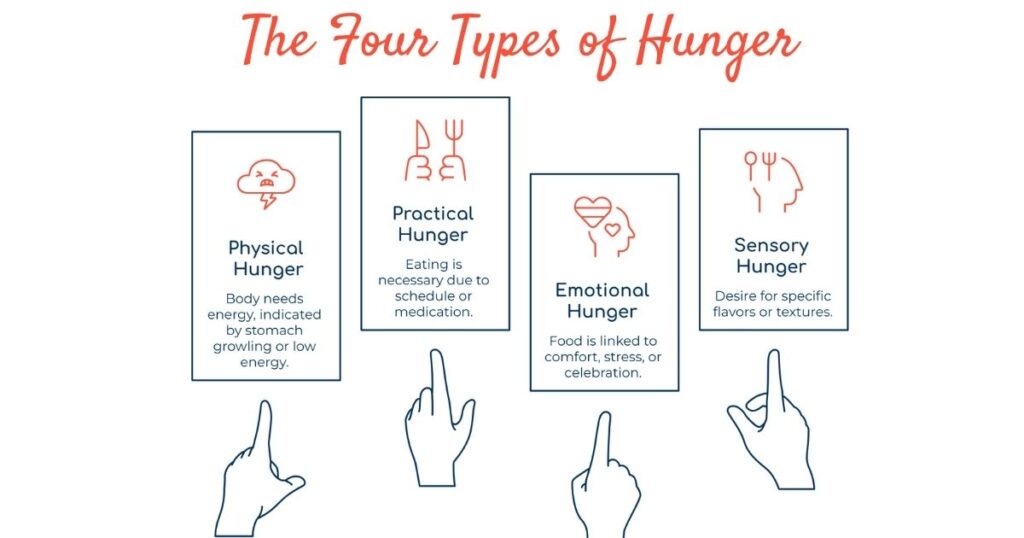
There are different ways to categorize hunger, but I like to think of 4 types:
Physical hunger
This is the kind of hunger most people think of first. Your body needs energy. You might notice a growling stomach, low energy, shakiness, irritability, brain fog, a headache, or more thoughts about food.
Practical hunger
This is when eating makes sense because of your real life. Maybe you are not hungry yet, but you have meetings all afternoon. Maybe you need to eat with medication. Maybe your appetite is low, but you know skipping a meal makes everything harder later.
Practical hunger is eating because your body and your schedule need support.
Emotional hunger
This is when food is connected to comfort, stress, boredom, sadness, celebration, nostalgia, culture, habit, or relief. It might show up after a hard day, during a lonely evening, at a family gathering, or when your brain is looking for something soothing and familiar.
Sensory hunger
This is when food sounds good because of flavor, texture, smell, temperature, appearance, or satisfaction. You might want something crunchy, cold, salty, sweet, warm, creamy, or familiar. This kind of hunger reminds us that eating is not only about nutrients. Food is sensory, and pleasure counts.
None of these are wrong.
They just tell us different things.
And once you can name what kind of hunger might be showing up, you have a better chance of responding in a way that actually supports you.
Eating is allowed to mean more than nutrition
Sometimes eating is about energy, blood sugar, digestion, mood, or getting through the afternoon without becoming a person your loved ones quietly avoid.
But other times, eating is about community.
It’s Taco Tuesday with friends, kolaches on a road trip, family barbecues, neighborhood cook-outs, and birthday cake at a party. It’s the meal your grandmother made every major holiday. It’s the food you eat after a hard day because it feels familiar and steady, or making the same soup every time the weather turns cold, because that is what comfort tastes like.
A lot of wellness culture likes to act like the “best” food choice is the one with the most nutrients, the cleanest ingredient list, or the least emotional attachment.
I disagree.
Food has always been more than a pile of nutrients. It carries ritual, culture, memory, pleasure, connection, comfort, celebration, and care. Ignoring that does not make us healthier. It makes eating feel colder, stricter, and more stressful than it needs to be. And it isolates us.
That does not mean every eating choice has to become a deep emotional experience. Sometimes a snack is just a snack.
But mindful eating gives us room to notice the full picture. Not just “Is this healthy?” but also:
- Does this connect me to people I love?
- Does this help me feel grounded?
- Does this make this moment feel more enjoyable?
- Does this support my mental health in a way that is not only about nutrients?
- Does this help me participate in my actual life?
Because yes, eating can support health. But it also supports being human.
We should be able to honor food as culture, comfort, ritual, pleasure, and connection with at least the same enthusiasm that wellness influencers bring to hating seed oils.
Physical hunger: when your body needs fuel
Physical hunger is the type most people think of first. It is your body saying, “Hey, we need energy.”
Sometimes that message is pretty clear. Your stomach growls. You feel empty. You notice that food sounds good in a general way, not necessarily one very specific food.
But physical hunger does not always show up as a polite little stomach rumble.
Sometimes it looks like fatigue. Sometimes it feels like shakiness, a headache, brain fog, or suddenly having the patience of a wet paper towel.
Or maybe it shows up as irritability, anxiety, or feeling like everything is a little too much.
This is one reason hunger can be confusing, especially if you already deal with anxiety or depression. Anxiety and hunger can feel surprisingly similar in the body. Both can come with shakiness, a racing feeling, nausea, restlessness, or trouble focusing.
Depression can make this even trickier because hunger cues can shift a lot. Some people lose their appetite. Others feel like they want to eat constantly, especially when food is one of the few things that feels comforting, accessible, or easy.
This is why I do not love advice that makes hunger sound simple.
For some people, “just listen to your body” works fine, though I find this is quite rare.
For others, body cues are faint, confusing, or tangled up with stress, medication, sleep, chronic symptoms, or years of dieting. You may need to look for patterns instead of waiting for an obvious signal.
A few signs of physical hunger can include:
- stomach growling or emptiness
- low energy
- shakiness
- headache
- brain fog
- trouble focusing
- irritability
- feeling anxious or unsettled
- suddenly thinking about food more often
- feeling more emotionally reactive than usual
And yes, I’m counting “suddenly everyone is annoying” as useful body data.
When you wait too long to eat, food decisions often feel more urgent and more emotionally loaded. It is harder to make a calm choice when your body is under-fueled, and your brain has moved into emergency management mode. At that point, the things people often associate with mindful eating, like slowing down, being present, or enjoying the meal, become much harder to do.
That does not mean you did anything wrong. It just means food may need to come first right now.
Practical hunger: eating before things fall apart
Practical hunger is one of the most helpful types of hunger, and also one of the most confusing.
Because it can feel like you are eating “when you’re not hungry,” but that is not really what is happening. Practical hunger is eating because you know something your body doesn’t yet.
Maybe you are not very hungry right now, but you have a long stretch of meetings coming up.
Maybe you need to eat with medication, even though breakfast does not sound especially appealing.
Maybe you are about to leave for therapy, school pickup, errands, a commute, or an appointment, and you know food will not be realistic for a while.
Or your appetite is low because you are depressed, anxious, overwhelmed, or stressed, but your body still needs fuel to get through the day.
This is where my love for hunger/fullness scales can get a little tricky. I do use them with clients sometimes because they can help you notice patterns.
A hunger/fullness scale is usually a 1–10 scale that helps you notice how hungry or full you feel before, during, or after eating. Maybe a 1 means ravenous, shaky, or desperate for food. Maybe a 10 means painfully full. Many people feel best when they start eating before they are overly hungry and stop when they feel comfortably satisfied.
That can be useful information. But it can also accidentally turn into another rule.
For example, let’s say breakfast usually gets you to a comfortable 7. That might be enough when you can eat lunch on your schedule or snacks are easy to grab.
But if you know lunch is going to be much later than you want, and you will not have time or opportunity to snack, mindfulness may mean eating a larger breakfast than what gets you to a “7.”
You’re not ignoring your body in this case. You’re including real life in your food decisions.
That is the piece people often miss.
While we start practicing mindful eating by focusing on right now, it is important that we start to think of mindfulness as future-focused.
For some people, “only eat when you’re hungry” sounds peaceful. But often, life goes on life-ing and we miss a hunger cue. Or we notice it, but we can’t do a dang thing about it, leading to physical and mental chaos.
It can look like hitting the afternoon shaky and irritable. It can look like coming home ravenous and eating whatever is fastest while feeling completely disconnected. Or blaming yourself for “losing control,” when the real issue started hours earlier with not enough food.
Practical hunger helps interrupt that pattern.
It gives you permission to plan ahead without turning food into a rigid schedule. It lets you eat before you are desperate. It helps you care for your body even when your preferred eating pattern doesn’t align with your day.
A few examples of practical hunger might be:
- eating breakfast with medication because you know skipping it makes it harder to eat later
- having a snack before therapy because emotional work takes energy
- eating lunch early because your afternoon is packed
- packing something easy before errands or a long commute
- eating even with low appetite because depression has muted your hunger cues
- setting a reminder to eat because disconnection between your body and brain makes it hard to notice what your body needs
Practical hunger is how you feed yourself before the wheels come off.
Emotional hunger: food as comfort, not failure
Emotional hunger is where a lot of people get nervous. Somewhere along the way, many of us picked up the idea that eating for emotional reasons is bad.
I do not agree with that. Food can be comfort and connection. Food can be memory, routine, celebration, and relief.
Sometimes emotional hunger shows up after a stressful workday, when your brain is looking for a way to shift out of “just get through it” mode. Sometimes it shows up when you feel sad, lonely, bored, overstimulated, understimulated, anxious, or completely worn out.
Sometimes it shows up as wanting something warm and familiar because the day felt cold and unpredictable.
Sometimes it shows up as birthday cake, holiday food, popcorn during a movie, or the meal that reminds you of someone you love.
That’s not wrong, it’s human.
Please don’t strip food of all emotional meaning. That would be a pretty joyless way to live, and honestly, wellness culture has already contributed enough weirdness to how people think about food.
Instead, notice what kind of comfort you need and give yourself more than one way to get it.
This is where emotional hunger becomes worth exploring.
Sometimes it feels distressing or compulsive. Sometimes it leads to shame, secrecy, or feeling out of control. Food may become the only way you know how to soothe yourself, transition out of a hard day, or feel something pleasant when everything else is not.
It can help to ask:
- Am I physically hungry too?
- What happened right before this urge to eat showed up?
- What feeling am I trying to shift?
- Am I looking for comfort, energy, distraction, grounding, connection, or a break?
- If I eat this, will I feel supported, ashamed, relieved, disconnected, satisfied, or still searching?
- Is there anything else I need alongside the food?
Alongside the food.
Not instead of the food. Or as punishment for wanting (or enjoying) the food. And definitely not as a moral upgrade.
Sometimes you may choose the comfort food and also need rest.
Or have the snack and text a friend.
Sometimes you may need dinner and quiet.
You may need something sweet and a real boundary with the person who keeps draining you. (and maybe something with protein alongside it, because comfort and staying power can coexist.)
Food can be part of comfort, but it likely can’t carry the entire job by itself.
And emotional hunger deserves curiosity before correction.
Sensory hunger: satisfaction counts
Sensory hunger is the desire to eat something because it looks, smells, tastes, sounds, or feels good. It appeals to one of your senses.
This is the hunger that shows up when you smell fresh bread, see a beautiful dessert, hear the crunch of chips, or suddenly want something cold, creamy, salty, sweet, warm, or crisp.
It generally doesn’t have much to do with how empty your stomach feels.
Sometimes food sounds good because food is supposed to sound good. We are sensory creatures. We respond to color, smell, texture, temperature, and flavor. That is not a lack of discipline. That is being a person with a working nervous system and a mouth.
Honestly, it would be weird if food never sounded good unless your stomach was growling.
A meal can technically meet your nutrition needs and still leave you feeling like something is missing. You might have enough protein, fiber, and calories, but if the meal feels boring, bland, or disconnected from what you actually wanted, your brain may keep searching.
That is one reason people sometimes graze after a meal and wonder what is wrong. You may be full, but not satisfied.
This is where diet culture tends to make things weird. It often teaches people to choose the “healthiest” option, even when it is not what they want at all. So they eat the thing they think they should eat, then spend the next hour picking around the kitchen trying to find the satisfaction they skipped.
Sometimes adding the thing you actually want makes your stomach and brain calm right down.
That might mean adding chips to lunch because crunch sounds good. It might mean having the cookie instead of trying to talk yourself into three other foods first, then eating the cookie later in the midst of a shame spiral.
It might mean choosing the warm meal instead of the cold salad because your body is tired and wants comfort.
It should definitely mean making your food taste good on purpose, with sauce, seasoning, texture, or something that makes the meal feel worth eating.
Pleasure is not the opposite of health.
And wanting food because it tastes good does not mean you are doing anything wrong.
Sensory hunger tells you something about satisfaction, and satisfaction is part of feeling cared for. Not every meal has to be exciting, but eating is allowed to be more than functional.
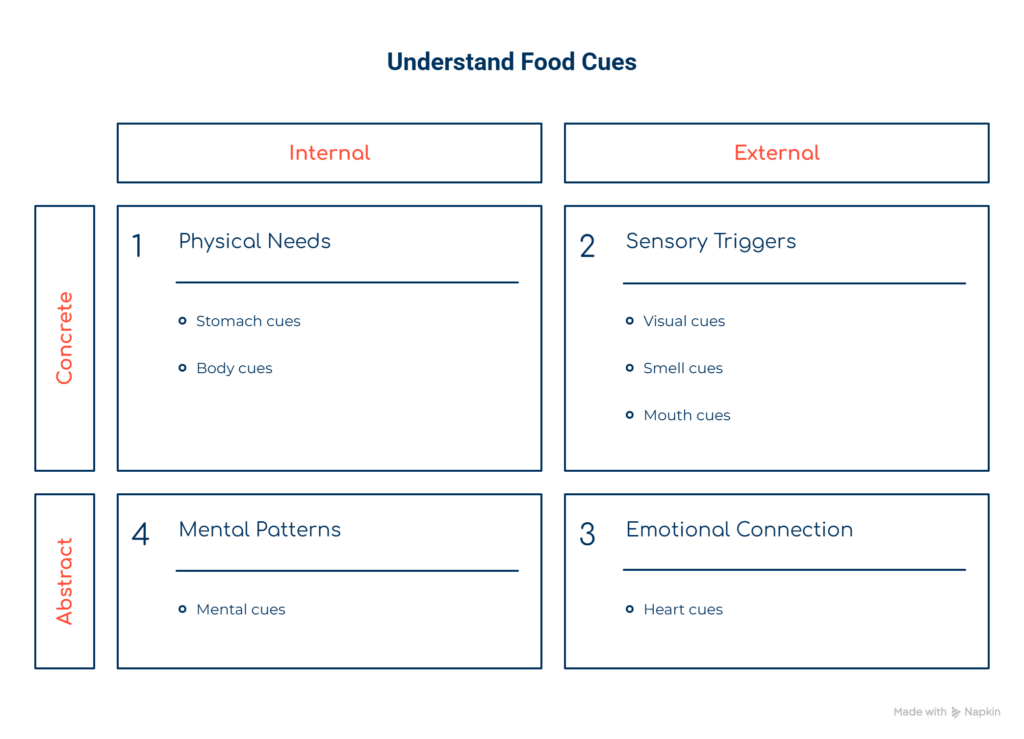
The 7 Food Cues Behind Hunger, Cravings, and Food Choices
The four types of hunger tell you which need is showing up. These cues help you understand what triggered it.
Some mindful eating frameworks describe these as different types of hunger, but I think that wording can get confusing.
Not every food cue is hunger in the physical sense.
Sometimes food gets your attention because your stomach is empty. Sometimes it is because something smells amazing, a food looks beautiful, your mouth wants a certain texture, or a memory gets stirred up. Sometimes it is your mind repeating old food rules. Sometimes it is your body asking for care in a way that does not show up as a stomach growl.
So instead of treating these as seven more hunger types to memorize, I find it more helpful to think of them as food cues.
They are different ways your body, mind, senses, or emotions may respond to food.
You do not have to label them perfectly. The goal is just to notice what might be influencing your food choices, so you can respond with more care and understanding and less judgment.
Visual cues
Visual cues happen when food catches your attention because of how it looks.
Maybe it is colorful, beautifully plated, fresh out of the oven, or sitting right in front of you at the checkout counter. There’s a reason that plating is always part of the judging criteria in food competitions.
This does not always mean you are physically hungry. It means your brain noticed food.
We are built to respond to our environment. Food that looks appealing can spark interest, especially if you are tired, stressed, distracted, or already a little hungry.
Example: “I wasn’t thinking about dessert until I saw it.”
You might decide to eat it, realize you’re not actually interested, or save it for later. The point is not to judge the cue, but to notice it.
Smell cues
Smell cues happen when an aroma pulls your attention toward food.
Fresh bread. Coffee. Popcorn. Garlic cooking in a pan. Food from a restaurant kitchen.
Smell is powerful because it connects closely with memory and emotion. A smell can make food feel appealing before you have even thought about whether you are hungry.
Example: “I smelled pizza, and now I want pizza.”
Again, this cue does not require an automatic yes-or-no.
It is simply a chance to pause and ask, “Do I want this? Would it be satisfying? Does this fit what I need right now?” If nothing else, this might solve the “What’s for dinner?” question.
Mouth cues
Mouth cues are about taste, texture, temperature, and mouthfeel.
This is the part of you that wants something crunchy, creamy, salty, sweet, spicy, cold, warm, chewy, fizzy, or smooth.
Sometimes, mouth cues are very specific.
You do not just want “a snack.” You want chips because you want crisp or crunch. Or chocolate because you want something sweet and smooth. Or soup because you want something warm.
Mouth cues are a big part of satisfaction.
If you ignore them completely, you may find yourself wandering back and forth through the kitchen, eating several things that technically “should” be enough but never quite hit the spot.
Example: “I want something crunchy.”
Fullness and satisfaction are related, but they are not the same thing.
A meal can fill your stomach without satisfying your senses. Noticing mouth cues can help you build meals and snacks that feel more complete.
Stomach cues
Stomach cues are the more traditional signs of hunger.
This might be a growling stomach, a sense of emptiness, gnawing, or a hollow feeling. For some people, stomach cues are clear and reliable. For others, they are easy to miss until hunger gets intense.
Stomach cues can be helpful, but they are not the only body cues that matter.
You may also notice physical hunger through low energy, shakiness, headache, food thoughts, irritability, brain fog, or trouble focusing.
Example: “My stomach feels empty.”
If your stomach cues are easy to notice, great. Use them.
If they are not, you may mean you need to pay attention to other signs too, especially mood, energy, timing, and patterns.
Body cues
Body cues are broader signals that your body may need care, even when it does not feel like classic stomach hunger.
This is where I like to be careful, because wellness culture sometimes turns this into “your body always knows exactly what nutrient it needs.”
Cravings can give us clues, but they are not a perfect nutrient report. They can be shaped by sleep, stress, hormones, restriction, habit, emotions, medications, culture, and pleasure.
So when I talk about body cues, I mean body-level needs that may be worth noticing.
Example: wanting gentle foods after being sick.
Just remember, these are cues, not commands.
Mental cues
Mental cues come from your thoughts, beliefs, habits, food rules, or outside messages.
This is the cue that often starts with “should.”
Mental cues can be tricky because they often sound responsible. But, in reality, they are usually disordered food rules wearing a blazer. When I work with clients on their relationship with food, these cues are usually the first we address.
A mental cue might cause thoughts like:
- “I shouldn’t be hungry yet.”
- “I should choose the lowest calorie option.”
- “I don’t deserve dessert.”
- “I should eat something lighter.”
- “I already messed up today.”
- “I need to eat perfectly this week.”
- “I was bad yesterday.”
- “I need to make up for that.”
- “I should want the salad.”
- “If I eat this, I’m out of control.”
- “A good person would choose something else.”
The goal is not to argue with every food thought. Instead, ask whether the thought is helping you care for yourself, making food more stressful, or degrading your self-worth. It can be helpful to pinpoint whose voice you’re hearing when you notice a mental cue.
Heart cues
Heart cues are those associated with comfort, memory, ritual, culture, celebration, grief, nostalgia, or a desire to feel cared for.
This is the meal your family made every holiday.
The soup you want when you feel worn down.
The birthday cake.
The popcorn at the movies.
The food from your culture that tastes like belonging.
The takeout you get after a hard therapy session, because cooking feels like too much, and you need the day to soften a little.
Heart cues are the main reason I do not believe eating should be reduced to nutrition alone.
Food can support health, yes. It can also support connection, comfort, identity, routine, and joy.
A heart cue might sound like:
- “I need something that feels steady right now.”
- “This reminds me of home.”
- “I want something comforting.”
- “This is part of how my family celebrates.”
- “I miss someone, and this food makes me feel close to them.”
Heart cues do not need to be treated as suspicious.
Sometimes eating for comfort is perfectly supportive. Sometimes it may show you that you need more comfort in your life than food alone can provide.
Don’t judge yourself for having these cues, and you don’t have to automatically obey them. But do see if they can help you understand what part of you is asking for attention.
A simple mindful hunger check-in
Once you start noticing different types of hunger and food cues, the next step is not to analyze every bite of food like you are preparing for a final exam.
The goal is to pause just long enough to gather a little more information.
For most people, a simple check-in is enough.
You might ask:
What am I noticing in my body?
Am I shaky, tired, tense, foggy, empty, nauseated, restless, or irritable?
When did I last eat?
Was it an hour ago? Four hours ago? Did I eat enough to actually hold me? Have I mostly had coffee and good intentions?
What is happening in my day?
Do I have time to eat later? Am I heading into a meeting, therapy, errands, school pickup, a commute, or anything else that makes food harder to access?
What sounds satisfying?
Do I want something warm, crunchy, sweet, salty, cold, easy, familiar, or more substantial?
What am I feeling emotionally?
Am I stressed, sad, bored, lonely, overwhelmed, anxious, celebratory, disconnected, or just plain done?
What would help me feel more supported right now?
Do I need food? A meal? A snack? Water? Rest? Quiet? Connection? A break? A boundary? A few minutes where no one asks me where their shoes are?
Most importantly, do not use the answers to these questions to shame yourself! You are not doing anything wrong should you choose to eat even though you ate an hour ago. But it may be worth exploring why you need to eat again so soon, especially if you find yourself in that same situation frequently.
What to do with what you notice
Once you have a better sense of what might be going on, you can respond in a way that matches the need.
If it seems like physical hunger, eat something with enough staying power.
That usually means more than a few bites of something random while standing in the kitchen. Your body may need a real meal or a snack with enough energy, protein, carbohydrate, fat, or fiber to help you feel steady.
If it seems like practical hunger, plan ahead.
Eat now, pack food, set a reminder, move lunch earlier, or choose something more filling because you know the day is going to stretch longer than your body comfortably can.
If it seems like sensory hunger, include satisfaction instead of fighting it.
Maybe the meal needs crunch. Maybe it needs sauce. Maybe you actually want the cookie instead of three “healthier” things that won’t satisfy you. Sensory hunger does not have to run the whole show, but ignoring it can increase food thoughts and start to derail mindfulness.
If it seems like emotional hunger, check physical hunger first.
A lot of emotional eating feels more intense when you are also under-fueled.
Then ask what else might be needed alongside food. Rest, comfort, connection, stimulation, quiet, movement, a boundary, or a transition out of work mode may all help. Food can be part of care. It just does not have to be the only care.
The point of this check-in is not to make every food choice perfect.
It is to help you stop treating every urge to eat like a problem, and start seeing it as information you can work with.
When hunger cues are hard to read
Sometimes hunger cues are hard to read.
This may mean your body has had to adapt to stress, dieting, trauma, illness, medication changes, depression, anxiety, or a schedule that does not leave much room for noticing anything until it is already urgent.
For some people, hunger feels obvious and predictable.
For others, it is quieter. Or delayed. Or tangled up with nausea, anxiety, fatigue, stomach discomfort, or someone else’s food rules.
Anxiety can make body sensations feel loud and confusing. You might feel shaky, restless, nauseated, or tense and not know if you need food, calming, water, medication, or a break from whatever is making your nervous system act like a smoke alarm with a low battery.
Depression can make hunger cues feel muted or exaggerated. Food might not sound good. Making a meal might feel like too many steps. You might know you need to eat, but getting from “I should eat” to actually eating feels weirdly hard. Or you may want to eat everything in sight.
ADHD and executive dysfunction can also make hunger cues harder to notice, especially when your attention is pulled in several directions, or you are hyperfocused on something else.
Dieting history can make this even more complicated. If you spent years ignoring hunger, delaying meals, tracking numbers, or judging appetite as a problem, it makes sense that trusting your body would not feel natural right away.
Chronic stress, trauma history, GI symptoms, neurodivergence, executive dysfunction, appetite changes from medication, and chaotic schedules can all make hunger cues less reliable, too.
This is where structure can be supportive.
Rules usually come with fear, guilt, and a sense that you are failing if you do not follow them perfectly.
Supportive structure gives you something to lean on when your cues are quiet, your day is messy, or your brain has too many tabs open.
That might look like eating every few hours, even if hunger is not obvious yet.
It might look like eating breakfast with medication because you know from experience that skipping it makes the rest of the day harder. Or planning an afternoon snack because 3 PM has a long history of taking you down.
It might look like keeping easy backup meals around for days when cooking is not happening.
It might look like setting a reminder to eat, packing a snack before therapy, or keeping “safe enough” foods available when your stomach feels unpredictable.
Sometimes it is:
“I know I feel worse when I skip breakfast.”
“I know I crash when I wait too long.”
“I know my appetite disappears when I’m anxious.”
“I know my medication sits better with food.”
“I know if I don’t plan something easy, dinner is going to become a whole ordeal.”
That counts as mindful eating too.
Mindfulness is not only about the present moment. It can also be future-focused. You can notice patterns, anticipate needs, and make a supportive choice before your body has to yell.
Final Thoughts
Hunger is not always simple, and it does not have to be simple for you to care for yourself well.
Sometimes your body needs fuel. Sometimes your schedule needs a plan. Sometimes your senses want satisfaction. Sometimes your heart needs comfort. Sometimes your mind is loud with old food rules.
You do not have to identify the cue perfectly.
You just need enough information to respond with a little more care and a little less shame.
If hunger cues feel confusing because of anxiety, depression, medication changes, chronic symptoms, or years of dieting, that is something we can work on in nutrition counseling. I provide virtual nutrition counseling for clients across Texas, including North Texas and Denton County. The goal is not perfect eating. It is building a way of feeding yourself that supports your real life.